Sunday, 12 May 2013

Reinforcing the lesson [Chinese tools]

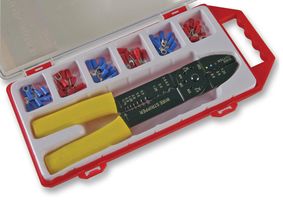
Not much activity on the mending front recently. However, as if to hammer home the point of my previous post, a new shipment of Chinese stuff has needed to be returned. CPC had several things in their special offers and Clearance lists, so I purchased two PIR alarms - exactly the same model that I purchased on Police recommendation some thirteen years ago, but now only £8 instead of £33. Also there was a Crimping Tool Kit which had metric bolt cutting slots for 2mm to 5mm screws, and my old one is only suited for BA threads. With a selection of crimp connectors and a carrying case, the kit was less than £3.50. I also needed some AA batteries (for the alarms etc) and they were offering a 32-pack of Philips ones for around £7.

DURATOOLD00010
DEFENDER SECURITYMA20
PHILIPSLR6P32F/10 


The stuff came promptly but was a disappointment. One of the PIR alarms was fine but the other proved to be missing a connector strip in the battery compartment, so could not be used at all. So much for the QC  inspection sticker...! Of the 32 batteries, five were leaking and partially discharged and as it was a sealed batch, I didn't trust the others - especially as they were going into the alarms for perhaps a year. The expiry date on each battery was October 2017. The rather weak crimp tool was completely Imperial and had nothing metric about it - all cutting points had American wire gauge designations and the AF threads in the bolt cutters would not accept metric screws. The crimp connectors seem flimsy and looked as though the PVC insulation would split when crimped, and finally both latches were broken off the case so it couldn't be closed.

Result: it all has to go back and we start again. I will accept a replacement PIR as they are usually good; the Crimp Kit was described as "metric" but probably isn't even available as such, and I will definitely be going for a different brand of batteries. My experience of Duracell is that even when discharged they don't leak (even though they too may be Chinese sourced, who knows). Maybe in time I will learn that a bargain is not a bargain unless it's a good product for a lower price than usual, and that bad products sold for their actual value are not a good investment.
================
UPDATE 11 July 2014
================
Given two apparently working PIR alarms, I installed them with confidence. After a few months, one has proved to be hard to use as the button action needs a really hard press, and the other has simply decided to sound off whenever it feels the need - even locked in a shed with no movement (and no insects or air currents etc). I should have known...serves me right.
===================================

When I was helping my father-in-law repair his garden shed, I leaned on the arm of his garden bench which promptly snapped off. The wood was rotten around the mounting bolt. I was intending to cut it out and let in a new patch of hardwood, but decided it was easier to replace the whole part with a new one in good pine. Having made a new bracket with the requisite holes, counterbores and such I soaked it all in wood preserver and gave it two coats of fence paint. It should now outlast the rest of the bench, and probably both my father-in-law and me too.

Tuesday, 16 April 2013

Chinese quality tools [Rotacraft and Proxxon accessories]

I own a Proxxon FBS 240/E multi-tool, similar to the Dremel, which I find very useful. I'm pretty happy with the quality and I've got a number of other Proxxon products as a result. In general they are well made, which is as well because they aren't particularly cheap. I've had to do a little fettling to the metalwork but nothing serious. They are supposed to be made in Germany and until the other day I had not seen any obvious clones, which is usually a sure indication that badge-engineering of far-eastern products is taking place. My tool holder uses a suction base with a spherical mount, and this particular model is no longer sold by Proxxon - they changed to a conventional clamp base - but the FMZ table vice is available with the clamp and also still with the suction base as the FMS 75. I was therefore surprised to see a very similar item being sold by Draper. I don't know whether this is the same thing from a common supplier, or a copy from China or elsewhere. It looks the same though, and is in the same price range, so it may be German. The fettling on my tool holder, by the way, was that I had to file away a casting seam and the paint from the ball to allow it rotate smoothly. The current production has the ball properly cleaned up with no paint and a smooth spherical surface. On the whole, at this price and quality I think these are European, because you can get something similar for only a few pounds - and which really IS rubbish.

The Proxxon FMS 75 vice...

...and Snap! But I quite like the blue.


The lesson I have learned finally, after repeated bad experience, is that it simply is not worth buying cheap tools. They are cheap for a reason, and if a tool won't match up to its job then it is worse than useless (because it may do damage). Many years ago I got a cheap set of Allen keys - early Chinese imports - and the first time I used them they simply twisted like sugar candy canes. A good Allen key will break before it bends, and even then not until it has been stressed far beyond the usual requirements. Cheap screwdrivers or bits will twist and damage the screw head. My first sharpening stone ('oil stone') wore away like chalk and when I added oil, it dissolved. I recently purchased a 1/2" twist drill bit from Machine Mart and had to return it due to the visible bend in it; the replacement was also slightly bent but not sufficiently to render it unusable for my application. In future I will only buy industrial quality drills from English, German or American manufacturers. Properly used, they will outlast my lifetime.

Anyway - back to the multi-tool - although the supplied accessories were OK there was only a limited selection, so when I saw a Rotacraft 400-piece accessory kit on offer I decided to have one, so that I would have pretty well everything I might need in a hurry. I should have known - the same kit is available under the Duratool brand, but missing lots of cutting discs and sold as a 150-piece kit. The swanky display box broke within minutes. This is a dead cert for a Chinese import, and unfortunately I paid the penalty. The first time I needed a micro drill I was drilling polypropylene plastic - not exactly a taxing job - and the drill simply refused to penetrate. The next size up was not much better but did drill a hole of sorts. I had a close look at the drill tip and it was off centre and had a flat across the tip - it wouldn't even make a good nail as it isn't hard enough or sharp enough. I also noted that one of the grinding wheels was incomplete and the rest were anything but round. I suppose you could dress them to be concentric, but I fear that they probably won't be much use even then.
Cunningly designed to not drill holes...

...or be any use at all.

The fact is, that if a tool is sourced from China or elsewhere and is cheap, it probably is worth only its price. The Chinese can certainly produce the highest quality goods - they couldn't get a space rocket to the moon using rubbish tools - but so can we, and they cost good money. Given that everything we buy from foreign suppliers has to be paid for by selling something else to them or by borrowing money (probably from them), I would prefer to buy quality tools whose price will go back into the European economy whenever I can afford it. This means doing  lot more research into the actual source of the things I buy, and whether they are fairly priced or overpriced, but in the end it is worth it.

Friday, 22 March 2013

Cyclones don't suck [Dyson DC07 HEPA]

I have a workshop and a small shed, and I wanted to move my Compound Mitre Saw into the small shed. As all the machines in the workshop are currently sharing a single dust extractor, I needed to provide a second one for the saw and - prices being what they are - I thought to make use of an old cylinder vacuum cleaner which I have around. I've fitted an extra (cyclonic) cylinder in series with the main extractor, to catch most of the chips and sawdust before they fill the can, and I thought to do the same with the second unit, when it occurred to me that I could get an old broken cyclonic vacuum cleaner and use just the body for the purpose. It would undoubtedly be more efficient than my home-made one. Accordingly I scoured eBay and ended up buying a broken Dyson DC07 HEPA for 99p, being first made to understand by the seller that there was 'a tube missing' - which I could see from the photo, as it didn't seem to have the small bent duct from the base unit to the handle assembly (just visible bottom left in the photo, above the wheel).

I found someone on eBay selling the relevant spare part for a few pounds and won it just in time to collect the broken Dyson. Unfortunately, as sometimes happens, the Dyson wasn't quite as described in that the seller didn't know much about it - when I got it home the 'missing tube' was in a bag of bits and in good condition. After some consideration I asked the seller of the spare tube not to send it and to refund me only the postage costs, keeping the sale price for his trouble and being able to re-sell it. That way he got to sell it twice and I paid out less than I would have done in the end.

The next job was to see what was really wrong with the Dyson. Two things stood out - one, the motor filter was totally clogged up and two, the top of the cyclone unit (the top of the 'rocket exhaust stack') was detached, with all three mounting pillars broken off. This was a setback because the cyclone housing needs to be air-tight and also, the top incorporates a handle which is so placed as to be exactly over the centre of gravity - so is used as a lifting handle to move the machine around even if its main purpose is to lift the dust container. Which is probably why it broke! There are quite a few people selling new cyclones, or clones of them, and there must be a reason for the market - they keep breaking. Unfortunately a new cyclone top would be over £30.

The motor seemed to be fine and all the parts were now present. If I had wanted to buy a new cyclone I could have done so without buying the whole cleaner and so I wondered whether perhaps the Dyson could be resurrected and provide the whole solution - needing no filters or bags and taking up less space than my old cylinder vacuum.

I cleaned up the whole machine after disassembling it. One problem was that the dust container was full and as the release catch was on the top of the cyclone - which was detached - it couldn't be opened. I had to do a lot of judicious fiddling with long sticks to release the catch, after which it was straightforward. The filters are washable foam, and new ones are easily available anyway but these came up fine. I had to free off some of the rollers on the base which had rusted up and also clean out all the nooks and crannies and the brush rollers, but that all went fine. Turning to the broken cyclone, it was obviously a case of having to reattach the three plastic pillars which had broken off the lower part (they were still held by the screws to the upper part), but I found that I was not the first to try and they were fairly mangled and covered in superglue. Clearly simply re-gluing them was not an option - the originals were not strong enough and certainly the glued broken ones weren't. The entire weight of the machine is lifted through those three small screws.

I began by cleaning up the parts with a sharp knife and files until they were back to their normal profile although not altogether complete. At this point I wanted to use epoxy putty to mould a strong buttress round each one, but the pillars are very close to the edge of the housing and there needed to be clearance for the flange on the top part to slide down between the pillars and the outside of the housing, to provide location and a seal - so the repaired pillar had to be much the same size as the old one but stronger. On the other side, the pillars were next to the air passages out of some of the cyclone chambers, which have to be clear for the thing to work at all. The heavier debris drops out of the airstream as it comes into the side of the dust chamber, then the remaining air with the smallest particles flows up into a plenum chamber where it is distributed between the eight mini-cyclones (the 'rocket exhaust' features). Each of these speeds up its part of the airflow until the dust shoots out of the top and falls through the middle into the dust container whilst the air returns to the motor fan through another tube. This is the same action as a normal cyclonic separator but is physically upside-down on this machine. They usually point downwards. Anyway, I refixed the broken stubs together with superglue just to locate them, then wound some wire around each pillar until it provided a continuous collar up the neck a bit like the native African tribe whose womenfolk used to wear stacks of metal rings to stretch their necks. Then I coated the whole pillar with epoxy glue, warming it slightly so that it became runny and soaked between the wire coils. It was necessary to provide a reinforcing collar of some kind because the threaded screw holes had become split and would not have secured the screws for more than a few threads at most. Once all this lot was fully cured, I applied a small amount of epoxy putty (Milliput) where there were gaps and moulded it smoothly back to the original contour of the pillar, with the screws in place but well greased. When it was set the screws could be removed and left a good thread set into a metal-reinforced pillar. As a result, the cyclone housing is now secure and the machine can be lifted by its handle - although I don't do it if I don't have to, just in case.

After reassembling the cleaner it seems to work quite well although the suction is nothing like it is claimed to be in the Dyson ads. As the brushes are good and the whole cleaner is basically serviced, I have to say that there is only one thing left. Some clown has superglued the cover accessing the HEPA filter (possibly because it kept coming loose) which means I can't get into it to replace the filter. Judging by the state of the rest of the machine, this filter is probably clogged solid and is covering the whole of the air outlet from the motor, so is blocking the whole operation. Although it will work OK as a sawdust collector as it is, I think I will need to cut open the filter housing and replace the filter, securing the housing by some other method (magnets?). I'll update the blog if/when I do this. Maybe it will be of more use in the house.....but then I'll be back where I began.....but whatever the outcome, a Dyson for 99p outlay is a bargain.
==================
UPDATE 11 July 2014
==================
I eventually cracked open the HEPA filter housing without having to cut it, and the filter was indeed almost solid. Fitting a new filter and seal restored the performance expected of a Dyson and my smile is even broader. The rest of the repair has held up successfully, so far.
Sunday, 17 March 2013

Prolonging life [Currys by Koss HP7022 headphones]

Back in the Dark Ages (1970s) I was looking for a set of hi-fi headphones and was shown these, badged from Currys but made by Koss - I was a bit sceptical because I had never seen open-backed over-the-ear phones with only a sponge ring as a cushion, but they delivered good solid bass and were really comfortable. I don't recall the price but at the time it was quite a bit for my limited budget. In fact since then I've come to realise that maybe the bass is a bit heavy, but it isn't boomy and resonant like some, so I like the sound.


They have a 1/4" stereo jack plug on a self-coiled cable which gradually lost its spring. It still just about self-coils but can't support its own weight any more, so it dribbles down from the hi-fi onto the floor and back up to my ear. There is a simple barely-padded headband and the transducers are circular and very plain. The cushions were simple rings of foam plastic and didn't do any acoustic sealing (as befits an open transducer), and when one transducer failed many years ago the replacement from Koss had no padding and I had to transfer the foam over, which was annoying as it was glued on. There is no overall shell, just the sealed transducer with a foam ring stuck to the front and a plastic cover on the back to mount it and cover the wire terminals. The headband adjustment is done by the transducers being gimballed on a serrated aluminium strip which slides through a gap in a plastic block. Somewhere in the block there is a detent of some sort, metal or plastic, which rubs the serrations and jams the strip wherever you leave it. Actually, they aren't much different in style than ex-GPO telephone receivers from WW2. Over the years the play between the strip and the detent grew until I could put the headband over my skull and the transducers would each drop with a clunk down to their lowest position. And then, eventually, the foam started to decompose and turn to dust until I had to simply strip it off. But they still sounded so good that I wore them anyway, which is pretty uncomfortable because the transducers have a domed front which pokes your lughole painfully.

Recently I finally decided to chuck them out, having lots of others, but still.....they sounded so nice....and they were very familiar....you know the story, of course I kept them. I looked around eBay and found some ear cushions which were intended for an AKG K81DJ set - simply circular (toroidal). Although not meant to be glued on, these have a flat back face and can be glued successfully with Copydex latex adhesive. And they were the right size, 75mm diameter. They look fine and work very well in the lug protection role. The loose adjustment was awkward as the little housings are riveted and to get into them I would have had to destroy the outside face. Instead I found a couple of very strong tension springs about 10mm long, with looped ends, and stretched them across the face of the strip on each side and wired them behind the headband. This has the effect of holding the strip against the detent inside its housing regardless of the other clearances and is almost invisible (apart from the white ties, which I will change when I have something brown).
 

I can't do much about the cable without replacing it completely so I shall live with the existing one, at least giving me the advantage of being able to walk across the room without it unplugging itself.  Not much work involved but it means that my favourite headphones can continue to give me pleasure for a few more years. And that's probably all I've got myself anyway!

Wednesday, 13 March 2013

Scrap from the sixties [Moulton Deluxe M2]

Some time ago - more than twelve years - I acquired a rusty old bicycle. It's so long ago that I can't remember the exact circumstances but I think it was found in a rubbish skip beside my place of work, having been added overnight by an opportunistic fly-tipper. I recognised it as a Moulton bike which was a bit of a fashion icon in the sixties, and I knew it had rubber suspension to both wheels which made it interesting. So I put it on one side for future attention; and now the future seems to be here.

The Moulton was a revolution for its day, being the first small-wheeled "shopper" bike. In fact it wasn't designed solely as a shopper, although they excel in that role. The small 16" wheels had very high pressure narrow tyres to minimise the rolling resistance, and the suspension was designed to compensate for the otherwise hard ride. The whole bike was designed from the ground up for efficiency and practicality and the result was a machine which, despite its innovative and very odd appearance, was able to outperform conventional bicycles - including touring and sports models - in every area. Unfortunately Raleigh didn't take kindly to the new upstart and being unable to replicate the design, produced their own version of a shopper with low-pressure balloon tyres and which lacking all of the unique features except the odd appearance, was inefficient, cheap and nasty. The problem was that it was cheap and the public didn't understand the difference, so they bought it in droves. In the end Raleigh bought out Moulton and took over manufacture and after a few years they dropped the Moulton products completely. Fortunately the designer, Dr. Alex Moulton, was able to re-acquire the patent rights later on and Moulton bikes continued to be developed and are still being made today. Now, however, they are very sophisticated and high quality, and can cost anywhere between £940 and £11000 each - a far cry from the £30-odd which a Moulton would have cost in 1963. Regrettably Dr. Moulton, who also designed the rubber suspension for the original Mini, died in November 2012 but his revolutionary designs are very much alive.

My skip find


My rusty pile was clearly one of the original models but as so many variations were made, I needed to find out more. I purchased a copy of  "The Moulton Bicycle" by Tony Hadland, which comprehensively tells the story of the Moulton Bicycle Company. From that I deduced that I had probably got a Standard or Deluxe from the mid-sixties - mine has a rear carrier but has been slathered copiously in blue Hammerite paint, which makes it hard to establish the original colour scheme or model name. However it had had chromed steel mudguards and a four-speed Sturmey-Archer FW hub gear, which were clues. I recently got a new copy of "The 'classic' Moulton" by Paul Grogan, not a cheap book but absolutely the best reference available. It shows full details of every Moulton F-frame model, colour and component that Moulton and Raleigh ever produced, with drawings and photographs and including restoration procedures, and I cannot recommend it highly enough to anyone interested in Moultons. This has enabled me to determine that I seem to have a Series One F-frame machine built at the Kirkby (Liverpool) factory in or around November 1964 (week 48) and was the 87th machine built that week (serial number 480087). It is likely to be a Deluxe M2 model but has lost its front carrier, its Moulton branded bell, its rear carrier bag and its original saddle, and has acquired a sprung mattress saddle, an anonymous bell and (possibly) non-standard brake callipers. The front calliper is unbranded and the rear one doesn't match those in the book. It has a short chromed steel chain guard and the unique optional long side stand. Everything is rusty and crusty; there is slight play in the steering and the rear suspension block is becoming unbonded. However it looks as though the frame and all the steel components are basically sound. At this point it looks depressingly likely that I will be driven to restore this bike to its original condition because there aren't that many around and it's so interesting, and it is an example of a machine which really was revolutionary. There are quite a few useful re-manufactured spare parts available for them so the quest is now on to locate the missing items if possible. It may take a few years and a lot of money - but I would really like to see this one looking as it came from the showroom.

Monday, 11 March 2013

Work in progress [Dawes Red Feather]

A while ago, I came across a bike which had been left behind by a departing University student. It had been mangled in an accident and left for dead, but it seemed in good condition otherwise and was a Dawes alloy framed hybrid. I had a Dawes Windsor tourer until recently - a lovely bike, handbuilt frame and decent components, but it had dropped handlebars and a non-indexing gear shift and I wanted something more like a mountain bike. So when I saw the redundant Dawes languishing I decided to see if it could be saved.

It's a Dawes Red Feather, like the one in the photo, but oddly it seems hard to find information about them. All the web searches come up with the latest Red Feather version, unlike this one, or a vintage fifties model again unlike this. This one is a hybrid with 700C rims, 7 speed Shimano derailleur with a granny gear and modern handlebars with an indexed short twist-grip shifter. The brakes are centre-pull callipers, the frame is a chunky alloy hand-built with oval section down-tube. It was just what I wanted but I have no idea when or where it was made.


 The bike had certainly had a hard bump - the derailleur mechanism was damaged and the drop-out was bent out at an angle, the back wheel was buckled and the front mudguard was shattered, and there is a chunk out of the crank spider. However after a clean-up it seemed worth a try.

The first problem was the drop-out. If it couldn't be successfully straightened then I might as well give up immediately. As it came out, I was able to apply leverage with a scaffold pole (strong and five feet long) and the drop-out realigned without breaking. The derailleur had to be replaced and after a detour caused by someone selling me one which operated the wrong way round, I eventually got a suitable new unit  for £25. The buckled wheel cost me £8 to find out that it was really beyond repair, but adjusting the spoke tensions has given me a straightish wheel which might do to make a trailer or some other light duty function. The new rear wheel cost £30 and some rim tape £2.50, then it was just a matter of transferring the gear set and the tyre. It looks as though a new mudguard set to match will be around £12; the crank spider is perfectly usable although it will probably be replaced at some point. The saddle has been replaced by a Lepper leather one which has yet to be moulded to my contours, so that's something to look forward to (not). Otherwise the bike is in much the same condition as the one in the photo and I hope to make good use of it. It will be the first bike I've had with an indexed gear change and effective brakes and I'm looking forward to getting out on it this summer. It really is "as light as a feather".
================
UPDATE 11 July 2014
================
I've used the bike for a while and it's great, but it has a problem with occasionally missing a gear. Research has shown that the derailleur set which was sold to me is "suitable for 7/8 speed cassette" but the hysteresis in the changer mechanism means the the exact positioning of the cage is slightly different when changing up through the range than when changing down. This causes one or other of the middle gears to be out of line with the cage so there's a glitch until a slight pressure is put to move the changer up or down from the indexed position, and that usually means jumping over the gear you were trying to select. I can live with that, but it illustrates the difficulties that can arise when you try to mix parts of different gear sets.

Friday, 8 March 2013

Simply Sony [Sony TC-FX25]

Today's special is a Sony TC-FX25 stereo cassette deck with no tape movement. The belts were all intact but had sat unused for so long that they had set into oval crispy things, so that was the first port of call.


This is a very straightforward deck - single playing direction, logic controls, manual selection of tape type and Dolby, LED bar graph recording level indicators and those horrid slide pots which were so popular at the time. You need to take off the top case (just a few obvious screws) and the bottom plate, which is held by three screws along the back edge and hooks under the front panel. The tape carrier door slides up and off with the door open. The front panel is clipped into place and just comes off forwards, and you have to disconnect a couple of plugs on the main circuit board to free it by threading the wiring loom out through the chassis. You can re-connect them directly to the PCB and the machine can still be operated, but note that on this old model, the mains transformer is fully exposed with tags carrying mains voltage on the top - I made up a cardboard box to cover the terminals while I was working on it.

To remove the transport mechanism there are four front-facing screws around its edge - coloured dark to distinguish them from any others. I needed to undo a few cable ties before the deck could be taken out, then disconnected some plugs on the main PCB - there are several similar but they are all different numbers of ways, so although I did make a map first, it's difficult to go wrong anyway. I guess it might help any viewer if I were to put in a scan of things like scribble maps, but I'm pushed for time at the moment. If anyone wants more info just stick a comment in.

The back plate with motor comes off easily allowing access to the first two of the four belts in this model. Again, without access to the exact replacement parts you have to do a bit of substitution. I found that the capstan belt was flat section, and CPC Farnell had a suitable one in their AVBELT5 (71mm dia. by 2.8mm wide, 0.5mm thick). The fast-forward belt driving the spools is replaced by an AVBELT76 (37mm dia. by 1.2mm square section). Then the back plate can be re-fitted.

The other two belts are accessed by removing the front plate and tape carrier assembly. This involves taking out a couple of brass screws each side which pivot the stays and I seem to recall there were a couple more at the top or side fixing the plate to the deck frame - but it was all pretty obvious. Once the screws are out, the assembly falls out forwards. It's probably worth keeping it in about the same position as it comes out, to save getting in a 'folding deckchair' pickle when re-fitting. At this point I was able to fit the other two belts - AVBELT69 (32mm dia. by 1.2mm square section) driving the take-up spool carrier, and the tape counter belt AVBELT100 (64mm dia. by 1.2mm square section) from the take-up spool spindle to the counter. As the tape counter is mechanical and still mounted on the main chassis, I left the drive belt loose having threaded it through the metalwork and then I re-fitted the front plate and tape carrier assembly. Throughout all this I made sure that I cleaned and lubricated the heads, pinch wheels and bearings as usual.

After putting it all back together, the tape mechanism worked perfectly with no slipping or wobble. Unfortunately there was only one channel playing and touching the PCB or wiring caused much crackling. Eventually I traced the problem to the tape head connectors - there seemed to be no dry solder joints so I used contact cleaner (Electrolube) on all the connectors, making sure to work them off and on to scrape off any tarnish. This sorted it out and the whole machine is now performing well.

This machine was hi-fi for its day but certainly not anything special, and even fully working it can't outperform any decent bit of kit - it's very basic. Added to that, it's not pristine - one or two rusty scratches - and uses cassettes which are hardly the medium of the future any more. But it has two standard (quarter inch) microphone inputs on the front and is still good for basic recording or transcribing old tapes, so maybe it will find a use somewhere. Anyway, it's satisfying to see it back in working order.