Showing posts with label Chat. Show all posts

Wednesday, 4 May 2016

Return of the Were-Rabbit* [Dutch Dwarf Lop]

Rabbits are very cute, I suppose, although skinny - when I handle a rabbit it always reminds me of a velvet pouch full of bones - but they have ferociously efficient teeth. I haven't been fully bitten, only nipped, but having seen what they can do to thin aluminium sheet and copper wiring, I don't want to have those chisel teeth anywhere near my flesh.

My daughters have for years had two pet rabbits at any one time (in rotation - one of the first pair had to be replaced as too aggressive, another disappeared overnight probably to sustain some nocturnal predator, and two died) and they had occasionally been allowed in the house. She Who Must Be Obeyed likes the idea of "house rabbits". I let this happen assuming that at least the poop would be cleaned up - not always the case, unfortunately - but I stopped it after discovering that the new sofa was ripped and the Christmas lights and my computer power supply lead had both been sliced into several parts by rabbity dentition. The power was on at the time, yet the perpetrator was unharmed. Maybe their teeth are made of a ceramic non-conductor.

Our first pair

Anyway, after an interval long enough for me to forget the above incident, Bagel - one of the current pair - was found demonstrating rigor mortis one day. The pair were well bonded and it was clear that the survivor Thumper would pine after his departed friend during the night, and the weather was cold with no cosy partner to snuggle up to. So my elder daughter decided that she would take him into her bedroom overnight until either a new partner was found or he was re-homed. I thought little about this as she is now old enough to deal with things like animal care. Or so I thought.

After a couple of weeks, one day when I eventually surfaced from my bed I was informed that there had been a power cut for several hours. On investigating I discovered that the 'power cut' was restricted to our own house, and no-one had thought to check the fusebox. In fact, the main safety RCD had tripped and resetting it restored the power immediately. A few days later it happened again, this time taking out the RCD and the Miniature Circuit Breaker protecting the mains power outlets. Resetting both restored power again, and I checked every item connected to the mains circuit downstairs but could find no problem. The next time it occurred I found that on resetting the trips they immediately dropped out again (but intermittently) and I spent the next two hours carefully inspecting every outlet in the house and its associated loads.

The fault, when finally revealed, was horrifying. In my daughter's bedroom, she had  a four-way power extension plugged into the wall outlet and had routed the cable under her desk, round the back of her high bunk bed and up to her bedside cupboard to supply lights and phone charger. She had created a curtained-off "den" under her bed into which she used to retreat to read in privacy, and she had lined the den with spare bedding and pillows and a bookcase. When I looked into the den I discovered that she had been using it as a rabbit hutch for Thumper , and she had not been cleaning up the rabbit poop and uneaten food. The bedding and carpet were soaked with urine. There were shredded books in evidence, and on lifting the bedding I found that the extension cable had been extensively stripped - all three wires were bared and had been sparking together. How a fire was avoided I shall never know. Even though the short circuits had tripped the MCB, the sparking could have caused the bedding/paper to smoulder and burn undetected.


Rabbit food?
The damaged wiring was removed and repaired but I kept it back until the room had been fully cleaned by my daughter and inspected for approval by parents. Needless to say, the rabbit was banished back to its usual accommodation and is now awaiting return to Rabbits 'r' Us to await a new owner.

This is posted as a cautionary tale, because we were lucky to escape more serious consequences (as was the rabbit). I have found that rabbits are able to bite through most materials and ours stripped out the carefully-fitted insulation in their hut and did considerable damage to the woodwork. They also kept digging tunnels under the fences, and undermined the foundation of our garden shed twice. Rabbit poop is relatively innocuous but is unpleasant when it is allowed to build up to six inches deep. During their stay ours have also seriously damaged a new sofa and several cushions, pillows and towels - plus the various electrical and other items. To add a final sting, when we contacted Rabbits 'r' Us to arrange his re-homing, they insisted on his having his immunisation renewed at our expense (and expensive it certainly was). All in all - I do generally love animals and the rabbits were cute, but I shall be heartily glad to see the back of them. We had a lovely cat but she had to go as my wife is allergic to the fur. We still support a dog, two goldfish and a horse; and my wife wants to keep chickens again...

[Names have been changed to protect the guilty]
  * With grateful acknowledgement to ©Aardman
 

Sunday, 22 February 2015

Re-launch tips [Shelves and roller blinds]

After a VERY long gap, caused by all sorts of personal things which no-one is interested in (except maybe a psychiatrist or a divorce court), I keep meaning to get back into the habit of documenting this stuff. I haven't stopped mending but I haven't felt like writing it down. In fact I haven't felt like much at all really; the Black Dog is at my heels. I decided to begin a New Phase of life.

So, to start off the New Phase, here's a couple of tips:

Tip 1- Roller Blinds.

These (the manual kind) have a habit of needing constant adjustment. The pulley at the end, with the string round it, is attached to the roller, and when insensitive clods jerk the string the knob on the other end of the string rises until the knob bangs against the bracket. The friction bond between the string and pulley slips a little and the blind's position relative to the string has changed. The net result of this is that with successive bangs, the roller blind goes up and up until it starts to jam at the top or doesn't reach the bottom any more when the string is pulled down to its full extent.

The official remedy is to unhook the roller blind, turn it over to unwind a turn of fabric and re-seat it in the brackets, which makes it one roller-circumference longer with the string position unchanged. What a hassle this becomes when you have a house full of clods.

My solution is to thread a long compression spring (such as a ball-point pen spring) onto each end of the string before the knobs are tied in place. Then (with everything adjusted to taste) the meteoric rise (or fall) of the blind is brought to a dignified stop, it doesn't slip its string and the adjustment remains correct. Clods can pull as hard as they want whilst civilised persons can choose their optimum blind parking position by feeling the tension. Simples.

>>UPDATE:  It seems that the insensitive clods are more persistent than I had assumed, as the blind is still being shifted (but not as much). Perhaps it's time to change to a different kind of privacy arrangement.


Tip 2 - Adjustable Shelves.

When using the slotted-rail shelf supports of the Spur type (<ahem>, other shelf support brands are available...) you are expected to fix the shelves by screws through the shelf brackets. If you fix them as far back as they will go, there is a half-inch gap between shelf and wall, and stuff keeps falling down. If you cunningly notch the shelf to clear the vertical supports so it fits against the wall this won't happen. BUT in either case you sacrifice the convenience of adjustability, because in order to move the shelf you have to tip it up at 45 degrees to allow the brackets to come free of the vertical supports - which you can't do with the shelf screwed down and fixed against the supports.

My solution is to mark and notch the shelf as above, to fit round the supports. Then the shelf is put to the saw and the rearmost 30mm or so of the shelf (including the notches) is cut off. The two parts are then replaced on the brackets and fitted snugly up against the wall - closing the saw kerf - and the front part ONLY of the shelf is screwed to its brackets. You then have a complete and gap-free shelf, but if you need to move it you just lift out the back 30mm strip which leaves a gap big enough to allow the shelf (with brackets) to be tilted and removed from the supports without unscrewing it. It can then be relocated at another position and the filler strip dropped back in to restore the neat installation.


Sunday, 12 May 2013

Reinforcing the lesson [Chinese tools]

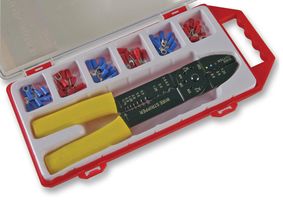
Not much activity on the mending front recently. However, as if to hammer home the point of my previous post, a new shipment of Chinese stuff has needed to be returned. CPC had several things in their special offers and Clearance lists, so I purchased two PIR alarms - exactly the same model that I purchased on Police recommendation some thirteen years ago, but now only £8 instead of £33. Also there was a Crimping Tool Kit which had metric bolt cutting slots for 2mm to 5mm screws, and my old one is only suited for BA threads. With a selection of crimp connectors and a carrying case, the kit was less than £3.50. I also needed some AA batteries (for the alarms etc) and they were offering a 32-pack of Philips ones for around £7.

DURATOOLD00010
DEFENDER SECURITYMA20
PHILIPSLR6P32F/10 


The stuff came promptly but was a disappointment. One of the PIR alarms was fine but the other proved to be missing a connector strip in the battery compartment, so could not be used at all. So much for the QC  inspection sticker...! Of the 32 batteries, five were leaking and partially discharged and as it was a sealed batch, I didn't trust the others - especially as they were going into the alarms for perhaps a year. The expiry date on each battery was October 2017. The rather weak crimp tool was completely Imperial and had nothing metric about it - all cutting points had American wire gauge designations and the AF threads in the bolt cutters would not accept metric screws. The crimp connectors seem flimsy and looked as though the PVC insulation would split when crimped, and finally both latches were broken off the case so it couldn't be closed.

Result: it all has to go back and we start again. I will accept a replacement PIR as they are usually good; the Crimp Kit was described as "metric" but probably isn't even available as such, and I will definitely be going for a different brand of batteries. My experience of Duracell is that even when discharged they don't leak (even though they too may be Chinese sourced, who knows). Maybe in time I will learn that a bargain is not a bargain unless it's a good product for a lower price than usual, and that bad products sold for their actual value are not a good investment.
================
UPDATE 11 July 2014
================
Given two apparently working PIR alarms, I installed them with confidence. After a few months, one has proved to be hard to use as the button action needs a really hard press, and the other has simply decided to sound off whenever it feels the need - even locked in a shed with no movement (and no insects or air currents etc). I should have known...serves me right.
===================================

When I was helping my father-in-law repair his garden shed, I leaned on the arm of his garden bench which promptly snapped off. The wood was rotten around the mounting bolt. I was intending to cut it out and let in a new patch of hardwood, but decided it was easier to replace the whole part with a new one in good pine. Having made a new bracket with the requisite holes, counterbores and such I soaked it all in wood preserver and gave it two coats of fence paint. It should now outlast the rest of the bench, and probably both my father-in-law and me too.

Tuesday, 16 April 2013

Chinese quality tools [Rotacraft and Proxxon accessories]

I own a Proxxon FBS 240/E multi-tool, similar to the Dremel, which I find very useful. I'm pretty happy with the quality and I've got a number of other Proxxon products as a result. In general they are well made, which is as well because they aren't particularly cheap. I've had to do a little fettling to the metalwork but nothing serious. They are supposed to be made in Germany and until the other day I had not seen any obvious clones, which is usually a sure indication that badge-engineering of far-eastern products is taking place. My tool holder uses a suction base with a spherical mount, and this particular model is no longer sold by Proxxon - they changed to a conventional clamp base - but the FMZ table vice is available with the clamp and also still with the suction base as the FMS 75. I was therefore surprised to see a very similar item being sold by Draper. I don't know whether this is the same thing from a common supplier, or a copy from China or elsewhere. It looks the same though, and is in the same price range, so it may be German. The fettling on my tool holder, by the way, was that I had to file away a casting seam and the paint from the ball to allow it rotate smoothly. The current production has the ball properly cleaned up with no paint and a smooth spherical surface. On the whole, at this price and quality I think these are European, because you can get something similar for only a few pounds - and which really IS rubbish.

The Proxxon FMS 75 vice...

...and Snap! But I quite like the blue.


The lesson I have learned finally, after repeated bad experience, is that it simply is not worth buying cheap tools. They are cheap for a reason, and if a tool won't match up to its job then it is worse than useless (because it may do damage). Many years ago I got a cheap set of Allen keys - early Chinese imports - and the first time I used them they simply twisted like sugar candy canes. A good Allen key will break before it bends, and even then not until it has been stressed far beyond the usual requirements. Cheap screwdrivers or bits will twist and damage the screw head. My first sharpening stone ('oil stone') wore away like chalk and when I added oil, it dissolved. I recently purchased a 1/2" twist drill bit from Machine Mart and had to return it due to the visible bend in it; the replacement was also slightly bent but not sufficiently to render it unusable for my application. In future I will only buy industrial quality drills from English, German or American manufacturers. Properly used, they will outlast my lifetime.

Anyway - back to the multi-tool - although the supplied accessories were OK there was only a limited selection, so when I saw a Rotacraft 400-piece accessory kit on offer I decided to have one, so that I would have pretty well everything I might need in a hurry. I should have known - the same kit is available under the Duratool brand, but missing lots of cutting discs and sold as a 150-piece kit. The swanky display box broke within minutes. This is a dead cert for a Chinese import, and unfortunately I paid the penalty. The first time I needed a micro drill I was drilling polypropylene plastic - not exactly a taxing job - and the drill simply refused to penetrate. The next size up was not much better but did drill a hole of sorts. I had a close look at the drill tip and it was off centre and had a flat across the tip - it wouldn't even make a good nail as it isn't hard enough or sharp enough. I also noted that one of the grinding wheels was incomplete and the rest were anything but round. I suppose you could dress them to be concentric, but I fear that they probably won't be much use even then.
Cunningly designed to not drill holes...

...or be any use at all.

The fact is, that if a tool is sourced from China or elsewhere and is cheap, it probably is worth only its price. The Chinese can certainly produce the highest quality goods - they couldn't get a space rocket to the moon using rubbish tools - but so can we, and they cost good money. Given that everything we buy from foreign suppliers has to be paid for by selling something else to them or by borrowing money (probably from them), I would prefer to buy quality tools whose price will go back into the European economy whenever I can afford it. This means doing  lot more research into the actual source of the things I buy, and whether they are fairly priced or overpriced, but in the end it is worth it.

Wednesday, 13 March 2013

Scrap from the sixties [Moulton Deluxe M2]

Some time ago - more than twelve years - I acquired a rusty old bicycle. It's so long ago that I can't remember the exact circumstances but I think it was found in a rubbish skip beside my place of work, having been added overnight by an opportunistic fly-tipper. I recognised it as a Moulton bike which was a bit of a fashion icon in the sixties, and I knew it had rubber suspension to both wheels which made it interesting. So I put it on one side for future attention; and now the future seems to be here.

The Moulton was a revolution for its day, being the first small-wheeled "shopper" bike. In fact it wasn't designed solely as a shopper, although they excel in that role. The small 16" wheels had very high pressure narrow tyres to minimise the rolling resistance, and the suspension was designed to compensate for the otherwise hard ride. The whole bike was designed from the ground up for efficiency and practicality and the result was a machine which, despite its innovative and very odd appearance, was able to outperform conventional bicycles - including touring and sports models - in every area. Unfortunately Raleigh didn't take kindly to the new upstart and being unable to replicate the design, produced their own version of a shopper with low-pressure balloon tyres and which lacking all of the unique features except the odd appearance, was inefficient, cheap and nasty. The problem was that it was cheap and the public didn't understand the difference, so they bought it in droves. In the end Raleigh bought out Moulton and took over manufacture and after a few years they dropped the Moulton products completely. Fortunately the designer, Dr. Alex Moulton, was able to re-acquire the patent rights later on and Moulton bikes continued to be developed and are still being made today. Now, however, they are very sophisticated and high quality, and can cost anywhere between £940 and £11000 each - a far cry from the £30-odd which a Moulton would have cost in 1963. Regrettably Dr. Moulton, who also designed the rubber suspension for the original Mini, died in November 2012 but his revolutionary designs are very much alive.

My skip find


My rusty pile was clearly one of the original models but as so many variations were made, I needed to find out more. I purchased a copy of  "The Moulton Bicycle" by Tony Hadland, which comprehensively tells the story of the Moulton Bicycle Company. From that I deduced that I had probably got a Standard or Deluxe from the mid-sixties - mine has a rear carrier but has been slathered copiously in blue Hammerite paint, which makes it hard to establish the original colour scheme or model name. However it had had chromed steel mudguards and a four-speed Sturmey-Archer FW hub gear, which were clues. I recently got a new copy of "The 'classic' Moulton" by Paul Grogan, not a cheap book but absolutely the best reference available. It shows full details of every Moulton F-frame model, colour and component that Moulton and Raleigh ever produced, with drawings and photographs and including restoration procedures, and I cannot recommend it highly enough to anyone interested in Moultons. This has enabled me to determine that I seem to have a Series One F-frame machine built at the Kirkby (Liverpool) factory in or around November 1964 (week 48) and was the 87th machine built that week (serial number 480087). It is likely to be a Deluxe M2 model but has lost its front carrier, its Moulton branded bell, its rear carrier bag and its original saddle, and has acquired a sprung mattress saddle, an anonymous bell and (possibly) non-standard brake callipers. The front calliper is unbranded and the rear one doesn't match those in the book. It has a short chromed steel chain guard and the unique optional long side stand. Everything is rusty and crusty; there is slight play in the steering and the rear suspension block is becoming unbonded. However it looks as though the frame and all the steel components are basically sound. At this point it looks depressingly likely that I will be driven to restore this bike to its original condition because there aren't that many around and it's so interesting, and it is an example of a machine which really was revolutionary. There are quite a few useful re-manufactured spare parts available for them so the quest is now on to locate the missing items if possible. It may take a few years and a lot of money - but I would really like to see this one looking as it came from the showroom.

Saturday, 2 February 2013

Archaeology revisited [Aiwa AD-R450]

As I now have some of the drive belts I need, I went back to my favourite cheapo cassette deck, the Aiwa AD-R450 which I was looking at last Sunday. It only took a couple of minutes to take off the backplate of the tape transport - a couple of screws and the plate was free to move out enough to thread in the flat drive belt. I had obtained service info and I was right about the belt path - from the top of the motor pulley, horizontally over to the RH capstan flywheel and down and around, up between the two flywheels and back to the bottom of the motor pulley. This drives the RH flywheel anticlockwise and the LH flywheel clockwise for the forward and reverse capstan drive.

 At this point I refitted the backplate and tested the drive - all was working now except the mechanical tape counter. To replace the counter belt, I had only to remove the four screws securing the whole transport mechanism  - two into plastic pillars right at the top of the front panel, and one each side into the base of the bottom tray (from inside) and pull back the machinery. Another two minutes to loop the new belt around the back of the take-up hub onto its integral pulley, then put back the mechanism and secure it and stretch the counter belt over the tape counter pulley. While the assembly was out, I took advantage of the easy access to clean up the heads, capstans and pinch wheels with some methylated spirit (wood alcohol to our colonial cousins).

This restored everything to full working order, and I had my old hi-fi deck back again.

The belts I used were from CPC Farnell, AVBELT9 (flat, 81mm dia., 3.5mm wide by 0.6mm) and AVBELT98 (61mm dia., 1.2mm square section). I had intended to try AVBELT10 (88mm dia., 4mm wide by 0.3mm) but this was out of stock. The original capstan belt was about 86mm dia, 5mm wide and 0.5mm thick - it's difficult to accurately measure a length of soft liquorice.....

The only comment I'd make was that the AVBELT98 was slightly too long and although it drives OK, will probably loosen fairly quickly. A better choice would have been the AVBELT96 (55.6mm dia.) or AVBELT95 (54mm dia.).

CPC's website is one of the worst for finding items. They have an astonishing range of stuff, and usually good prices, but the organisation and search is rubbish. For example, to get a drive belt you can eventually find your way through the menus in the sidebar (> Components, Kits & Spares > Spares (Brown & White Goods) > Audio Spares > Belts > Square Section) but then you're presented with a filter matrix. If you select just one wrong box, you will get wrong answers. By selecting the minimum of filters, you can get a matching list of bits (belts, in this case), but they are in apparent random order. They show part numbers, prices and the Length - by which in this case they mean DIAMETER - and the depth - by which they mean WIDTH. If you click 'More details' the actual item page shows the price and hopefully an accurate picture (but sometimes generic) but no dimensions, If you select the obscure "Further Information" link from there, you get a list of EVERY belt with dimensions and a BUY NOW link, but no prices! When searching for a number of possible alternatives, as you do with belts, it's a matter of having a very good memory and the patience of a saint. Many times I have tried to find something in CPC stock and given up, only to find out later that the item was available but classified as something else. And the filter options rarely filter the things you want to filter.

Another point to note with CPC is that they very kindly send you sales flyers - floods of them! - listing the current special deals. The catch here is that the last two digits of the part number are specific to the offer catalogue only, and if you try to get something from that catalogue after the offer period has expired it will show a 'Not Found' error. Disregard the last two digits and search again, and you will probably find the item still in stock but at a different price. You may be happy to buy at that price as it may be better than thinking you aren't going to get it at all. Once I tried to be an arrogant smartarse and thought I would remove the last digits because I didn't like my buying habits being logged (from a given catalogue). Hoist by my own petard, I was charged the full off-sale price for everything. And serves me right.

Friday, 25 January 2013

You've got to start somewhere [Dragonbone]

Well, here I go. My first Blog. It's a strange feeling, because I'm a very private person and I worry about putting stuff out there for posterity - once it's said it can't be taken back, etc etc. The hell with it - I'm old enough not to care any more.....

The idea of this, is that I seem to spend most of my time mending things, which I find very rewarding on several levels. When you have some artifact which isn't functioning in some way, many folk would simply dump it in the bin and buy another. But that's how all the ordinary stuff disappears - have you seen one of those pointy tin openers they used to pierce the Party Sevens? No, thought not. The Party Sevens disappeared and so did the tools - not that it matters much really, but a museum might think otherwise.

Then there's the economics. Mostly, what I mend is pretty worthless and costs more to mend than to buy a new one. But that's without considering the environmental cost, and the emotional value (toys, for example), and the personal satisfaction of overcoming a challenge. There's also, in my case, a pleasure to be had in seeing a machine working as well as it ever did, and often better. So that's why I mend.

Since I spend so much time doing it, I wondered if others might be interested in the work. I often get people marvelling in the ingenuity of a repair or seeing a way to fix their own stuff that they hadn't considered. People also say that most folk don't know how to fix things, and if I do, then maybe I ought to tell them. Not that I do anything special, but I do try to do it properly. Unfortunately I have a bit of Asperger somewhere in me, which leads to a tendency to talk to other people about my personal interests until the glazed look has turned into a murderous stare. Other people can apparently see this but it seems that I can't. I thought that maybe a blog would allow me to vent my desires without offending anyone who can't switch me off.

At the moment I'm working on a batch of broken hi-fi units, mostly cassette decks with soggy belts or other faults. I've also got a toy truck's towing hitch to finish, the fridge to sort out and a shed full of bikes, toys, electronics and other bric-a-brac which all need some kind of attention. I intend to post a snippet every so often about the progress, or otherwise, of these things. Then I can imagine the rest of the world gasping in astonishment, horror, mirth or pity. Actually I'm probably the only one who will ever read these little confessions so it matters not.

 So that's it for now. Next time I'll put some meat in the sandwich, so to speak, and who knows where it will go from there. By the way, the "dragonbone" in my username refers to a device I had once, purchased in Madison (Wisconsin, USA):

....which was basically an electronic dice (die?) which could be switched to have as many 'sides' as you needed. It was for use in Dungeons and Dragons and other like pursuits, games which often used odd-sized dice to decide who won a battle, or how many steps to move. This was before computer games got going. Anyway, it was fashioned to look like a bone with 'jewels' (LEDs) all the way along, and a bit at the end which you twisted to select the sided-ness - so if you selected 12 and pressed a stud, it would light up the LEDs to indicate a random number between 1 and 12. It seemed like a neat name for a neat gadget incorporating wizardry, mystery, oddity and dorkishness. Just like me.